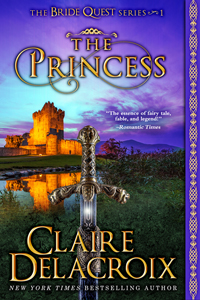
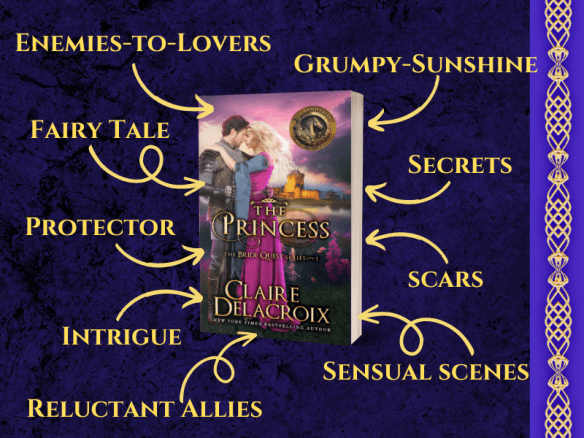
Princess Brianna of Tullymullagh is determined to marry only for love—until her father’s holding is conquered and the king decrees that she must wed one of the victor’s sons. Thinking she can outwit this condition, Brianna issues a challenge: the son who brings her a gift that makes her laugh will win her hand.
Thus begins the Bride Quest of the three brothers Fitzgavin.
Burke and Rowan, knights both, ride out on Brianna’s quest, each intent upon triumph. Only Luc refuses to participate, for he knows that a princess had no place in the life of a battle-weary warrior like himself. Brianna is not inclined to accept his refusal—she tempts him and awakens his slumbering senses with her alluring beauty and her sweet kisses. Luc has sworn to lay down his sword forever—until he is the sole one who can defend the fair maiden who has claimed his shielded heart.
“Claire Delacroix is the queen of medieval romance! Reading The Princess is like sipping vintage wine—delectable!”
Rendezvous
USA Today Bestselling Title
“Exquisite! A marvelously beautiful tale of love!”
Bell, Book & Candle
Winner
1998 Best Historical Romance
Colorado Romance Writers’ Award of Excellence
Finalist
1998 Best Historical Romance
Holt Medallion
Finalist
1998 Best Medieval Historical Romance
Romantic Times
“The essence of fairy tale, fable and legend!”
Romantic Times
Buy The Princess ebook:

“Delacroix captured me with the first sentence…and left me wanting more! Her musical style of writing transformed this story into a bard’s tale of knights, quests, mystery and love.”
All About Romance
“[Claire Delacroix] has a magical, lyrical style of writing that captures the reader from the first page. Add mysterious secret treasure, as well as several murders, to this wonderfully passionate romance and you have an exciting medieval that’s not to be missed.”
Old Book Barn Gazette
Buy Trade Paperback:


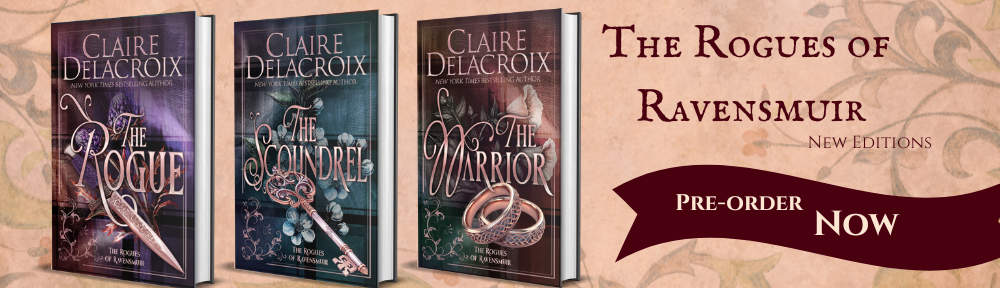
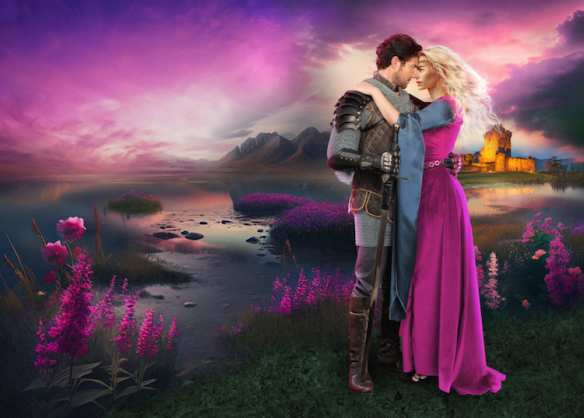
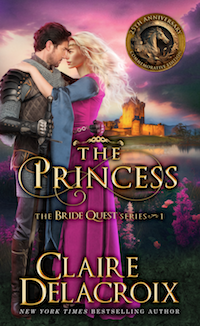
To celebrate the 25th anniversary of the publication of The Princess, I’ve created new editions of the Bride Quest books. There’s a new cover illustration for each book in the series, appears on the new mass market paperback and the new hardcover edition.
Here’s the pretty new cover illustration of Luc and Brianna:
Here are all four editions of The Princess: from left, the ebook, the 25th anniversary commemorative mass market edition with new cover art, the current trade paperback edition, and the 25th anniversary commemorative hard cover edition at right.
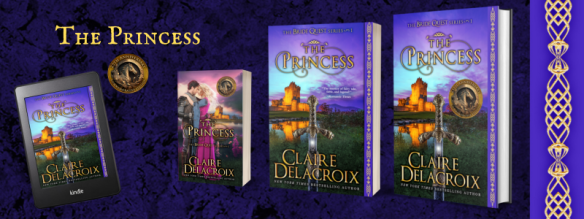
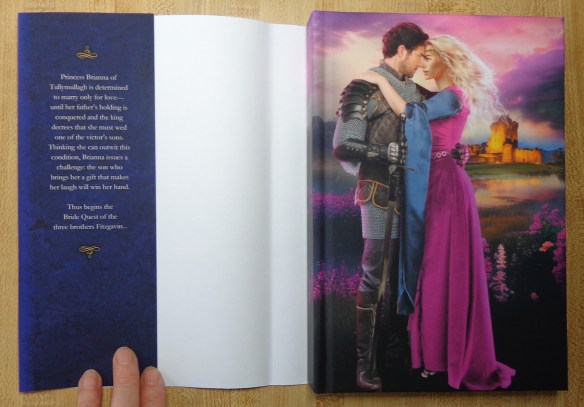
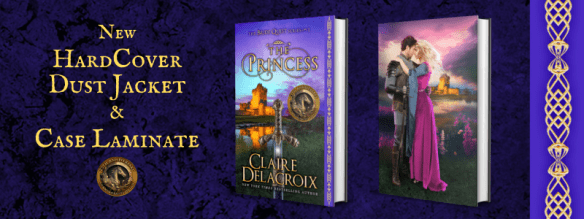
The new hardcover editions have a dust jacket similar to the current trade paperback – but with the new seal for the anniversary editions. But instead of a plain case, these books are case-laminated, which means there will be an illustration on the actual book cover. The idea is to evoke those stepback covers we knew and loved. You get BOTH covers with the hardcover.
Here’s a photograph of the actual book. In this picture, I’ve removed the front of the dust jacket and you can see the case laminate. The illustration continues around the back without type – there’s just the bar code on the back.
The commemorative print editions include a new letter from me and the hardcover editions include the Bride Quest family trees. They’d be too small to read in the mass market edition, but you can download them free right here and print them out.
The trade paperback and the ebook editions remain as they were.
There are similar new editions of the other five books. There also is a new bonus epilogue to catch up with the family called Christmas at Tullymullagh, which is included in the new print editions of The Heiress. Christmas at Tullymullagh is also available on its own in ebook.
Buy the 25th anniversary commemorative mass market paperback of The Princess:
Buy the 25th anniversary commemorative hard cover edition of The Princess:
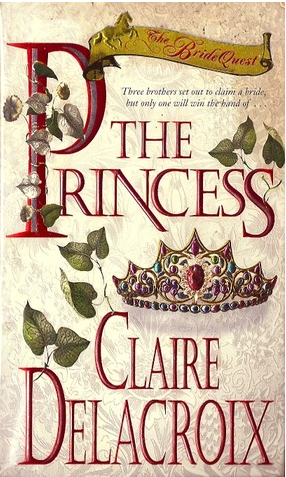
The Princess was originally published by Dell. I have a limited number of the original mass market paperbacks available for sale in my online store.
An excerpt from The Princess
Luc was not particularly surprised to see Brianna striding through the courtyard toward him, her kirtle flying out behind her.
What did surprise him was that it had taken her so long to come. In his experience, indulged women were quick to note deficiencies in their attendance. Brianna tugged off her veil and cast it impatiently at the ground with a marked disregard for convention. The orchard was clearly her destination and her mood was evidently less than prime.
What doubly surprised Luc was the wave of anticipation that rolled through him. Indeed, Brianna was even more alluring in her anger than she had been in the hall and Luc’s blood quickened that he was the target of her anger.
As she drew nearer, Luc saw that Brianna’s eyes flashed, a flushed spot burned in each cheek. She gathered up her skirts and strode into the orchard with purpose, indifferent to the survival of her fine shoes. Burrs and dried weeds snatched at her gown but she strode on, eyes flashing emerald fire, oblivious to every obstacle.
She was magnificent. Luc found himself turning to confront her and bracing for a battle of words, without ever having had any intention of doing so.
“You!” Brianna jabbed one finger through the air. “You cannot stay here. You simply cannot!”
Luc folded his arms across his chest and surveyed the approaching princess with feigned indifference. “I just have.” He shrugged, purely to infuriate her.
It worked.
“Oh! You are insolent! I am the princess of Tullymullagh and I will not permit you to remain.” Brianna snagged her kirtle on the branch of a tree and gave the garment a frustrated tug. A slight tearing sound resulted. If Luc had expected her to moan over the damage, he would have called her response wrong.
The princess glared at Luc, cursed, and clutched even more of her voluminous skirts before continuing toward him. She came to a breathless halt before him, tipped up her chin, and looked him in the eye.
And she had a dangerous allure with such proximity. The ripe curve of Brianna’s breasts was within a handspan of Luc’s chest, the fan of her breath brushed his skin. A waft of a feminine scent—Luc fancied ’twas attar of roses—set a heat unfurling in his belly.
Ye gods, had he ever met a more beguiling woman?
“I shall force you to follow my quest!” she declared vehemently, her eyes flashing.
Luc let himself smile. Brianna was a good bit tinier than he and ’twas amusing to consider how she might singlehandedly compel him to depart.
“Indeed?” he could not help but ask.
His smile clearly did naught to improve her mood. “Indeed!” Brianna retorted. “Why, I shall call the gatekeeper this very moment and have him escort you to the road.”
Luc arched a brow and glanced toward the gates. “The gates have been closed since sunset.”
Brianna spun to look, her golden hair whirling around her shoulders, the wavy tresses evidently having worked free of her braid. Luc was certain he had never seen hair of such an incredible color. It made him want to touch it, but he had no more than lifted his hand before she spun back to face him.
Her lips had thinned that he spoke the truth, but she squared her shoulders regally and looked him dead in the eye.
Indeed, the lady did not surrender the field readily. Luc could not help but admire her persistence.
“You may pass through the broken wall, as the invaders did,” she charged.
“Ah, but ’twould not be seemly,” Luc returned solemnly.
“Seemly?” the lady echoed in an indignant hiss. “What is not seemly is your lingering here when I have granted a quest.”
“Yet here I will remain.” Luc turned and deliberately nicked a spur from the closest bough with his blade, knowing that his indifference would trouble her greatly.
’Twas impossible to resist.
“There is no place for you to sleep,” she claimed, with a toss of her wondrous hair. “I am quite certain that all pallets are claimed this night.”
“I will sleep in the stables. ’Tis no trouble at all.” Luc granted the lady his most winning smile.
Her nostrils flared. “I shall forbid it!”
“But the arrangement is made.” Luc leaned casually against the tree, intrigued by her determination to be rid of him. “Indeed, your ostler is most kind.”
Brianna stamped her foot. “You cannot do this! You must leave on my quest.” She fixed Luc with a bright eye and her voice lowered. “’Tis how it works in every bard’s tale— how can you be so cursedly stubborn?”
Before Luc could ask her the same question, the lady took a deep breath and glared at him anew. “Have you forgotten that you were summoned, after all, to compete for my hand?”
“That may be so,” Luc acknowledged easily. “But I came for an entirely different reason.”
The lady blinked and was momentarily at a loss. “You did?”
“Aye. I came to discuss another matter with my father.” The lady appeared uncertain how to proceed in the face of this information. She looked at Luc, at her hands, at the ground. From what he had already witnessed, Luc suspected ’twould not take her long to chart a new course. He watched and waited, expectant.
He was not to be disappointed.
Excerpt from The Princess Copyright ©Claire Delacroix Inc. 1998, 2017, 2023

 Claire Delacroix